What do we mean by design?
Design is a very slippery word and so it is necessary to take some space to define and discuss just what we mean by it.
This section will look at many varied facets of design and the experience of design across many different products and services.
Perhaps the first step is to simply list the words that often precede design
- experience
- industrial
- graphic
- product
- service
- interaction
- user interface
- …
Jesse James Barrett view of experience design (below) adds more to that mix (e.g. sensory design, navigation design, information design). Although he was very concerned with website design and web-based experiences, everything in his picture is still very important and is part of what has to be designed.
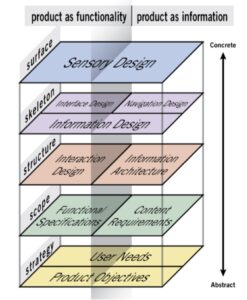
However, it is very much attached to a view of the usage by a single person of a single product. It doesn’t start to address design of the impact of this product on others, for example. Insofar as one might claim that it does address them, then they would be in the ‘strategy’ layer (User Needs and Product Objectives).
Furthermore, a ‘designer’ is often trained (or has practised) in a few of these skills and rarely in all. Indeed, having a talent for one of these areas of design does not mean that the person has a natural talent in all the other areas. Although many people call themselves ‘user experience designers’ and imply that they can cover the full-stack of design, my experience is that this is very rarely true.
And as soon as one is designing a piece of hardware as well, then a generalist UX designer is going to struggle.
Therefore, we need to embrace experience design as requiring a diversity of design talents, and thereby often requiring a team of designers, not a solo designer.
Returning to the question of the meaning of ‘design’, perhaps the best (simplest) encapsulation would be to say that design is the process of defining what it is that needs to be engineered, ideally in such a way that the builders of the product (or service) can know whether what they are building is actually what is wanted. And yet this is precisely where UX Design becomes a tricky concept, since the experience is not engineered, or manufactured, or sold – the designed components enable an experience (or not) but they don’t individually deliver it.
Perhaps the best example of this conundrum can be found in the world of home entertainment where almost every product involved has its own UI and its own apps and those apps may also have their own UI. Apart from deliberately buying all your TV components from the same brand, none of those designed products really have control over the user experience since they cannot know what other products they have to play well with.

The content shared here is trying to explore what UX Design might really mean – is it even possible?