Skip to content
People-centered Design
People
Design
Business
More …
Thinking about AI
Prototyping UX
People
Design
Business
More …
Thinking about AI
Prototyping UX
What’s New?
Usability considered harmful …?
Not necessarily the same as gathering input from users, ‘usability’ often implies a rigorous testing of a product or interface (in A-B testing or similar). But such rigorous, data-driven processes can arguably be quite detrimental to successful product or service design.
UX strategy or Design Strategy?
Brand strategy and design strategy seem to be well understood terms, but the idea of an experience strategy seems to be a step too far for many (is it not just the same as one these other two?).
THE HAZARDS OF USER DATA AND FEEDBACK …
It seems almost sacrilegious to say it, but I think it is really important to maintain significant caution around data obtained from user feedback, testing or group discussions. Too often I hear people proudly say that all their design decisions are based on feedback from users, or one hears leadership asking that all the design decisions be based on documented data from user feedback. These attitudes are, of course, well-founded, but at the same time they are seriously misguided – and for a number of different reasons …
What is the role for data and AI?
Increasingly the experiences we are designing products for entail the collection and sharing of lots of data. As well as the broader questions about who owns the data, there is also the need for the presentation of data to be designed and it isn't obvious that traditional design methods address this very well.
Don’t write interview guides
If you are going to meet with users and do some qualitative research then I expect (hope, even) that you have had it drilled in to you to carefully construct an interview guide. Now, I ask you to remember that lesson, but throw away the interview guide! The very reason we take the time to go and meet with our users is to learn from them and to discover new insights about their behaviours, needs and desires. The very concept of an interview guide implies that you are taking the lead and guiding them. Which, in turn, implies that you know what needs to be talked about ... so what is the real chance of uncovering new discoveries here?
A map of whose journey?
Journey maps, experience roadmaps, customer experience journeys are all common tools nowadays, but a key question that needs to be asked is "whose journey are we mapping?" and is that the right person?
Maps are Selective
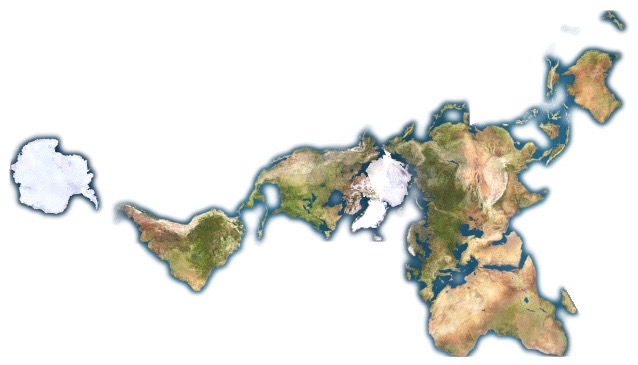
Journey maps, user mapping, and many other methods all aim to produce a map of some facet of the user experience. In this context it is useful to reflect on the fact that 2D representations of a 3D world are always inaccurate – even while being phenomenally useful.
The compelling touchscreen – who benefits?
Touchscreens and touch interfaces are all the rage – but is this a people-centred movement? Arguably the strongest push for the use of touchscreens is the updatability of them – with a firmware update the UI can be changed significantly. But there are also strong marketing pressures as it is a common belief that touchscreens make a product feel more modern and innovative. Nowhere is this more apparent than in the car, where touchscreens increasingly dominate despite very good reasons to doubt their value to the driver.
Can we judge design from a single concept?
In the real world of commercial product design it is not uncommon for (UX) designers to spend most of their time working on the nuts and bolts (pixels and screens) of a single concept. But in order to identify the best approach to meeting the constraints of user needs, commerce and technology it is unlikely that the first concept is the optimal one. There is a reason many designers like to have a sketch books.
Writing a good conversation guide
The trick to creating a good conversation is appear as though you do not have a conversation guide (even though you do) and to be prepared to be authentic and allow the conversation to wander wherever it goes. One way to assess the authenticity of a conversation would be in terms of the number of times you (and your conversationalist) are surprised by it, or find new ideas in it. In an authentic conversation the participants are equally able to lead (or block) any avenue of exploration. Your conversation guide must then provide you with a good idea of the avenues you want to go down and why.
The importance of empathy
Who needs to understand who? But with whom? Most work focuses on our empathy with our customers or users, but it may often be the case that we need empathy with our colleagues even more.
Making things better?
Are we (UX, design and product management professionals) expending enough energy on reflecting on what works and what doesn't. Today it still seems to be the case that people argue for the financial (commercial) benefits of UX or of design, without addressing the question about the quality of that design that might be needed for those benefits to accrue.
Design?
Design is a very slippery word and so it is necessary to take some space to define what we mean by it. This section will look at many varied facets of design and the experience of design across many different products and services.
Business and technology
Product design is a complex balancing of conflicting constraints and what works for a product idea in one company might be very different than would work for the same idea in a different company. Given that – does it really make sense to say the design is centred on anything?
Experience is infinite
Where does experience start and stop? Few products exist in isolation of a broader context filled with (and interacting with) other people and other products and services.